Resume
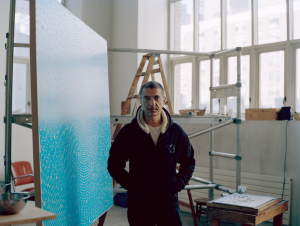
In paintings, drawings, collages, and sculptures, Y.Z. Kami explores the flux between matter and spirit, external appearance and inner life. In both large- and small-scale portraits, he restages face-to-face encounters, using sfumato to depict family, friends, and strangers with eyes open or closed, gazing straight ahead or looking down. Rendered in matte oil paint on linen, these meditative images recall Byzantine frescoes and Fayum funerary portraits, locating the unknown and the infinite in material form and presence. In his abstract works, Kami extends this interplay of surface and interior through forms inspired by architecture, geometry, poetry, and, more recently, hazy, oneiric imagery.
Kami was born in Tehran in 1956. He painted from early childhood, sometimes with his mother, who was an artist, and was exposed to both Western and Near Eastern influences, particularly the paintings of the European masters and the verses of thirteenth- and fourteenth-century Persian poets. Following high school, and after a year spent in Berkeley, California, he moved to Paris. There he studied philosophy at the Sorbonne—from which he graduated in 1981—and subsequently at the Conservatoire Libre du Cinéma Français.
In 1984, Kami moved to New York, where he continues to live and work. There, he started work on Self-Portrait as a Child (1990), which marks the beginning of a series of paintings, drawings, and photographic works based on a picture of himself as a boy in Iran. Over the subsequent decade he produced multipart works, including Untitled (18 Portraits) (1994–95), and Untitled (16 Portraits) (1997–98). The latter is in the collection of the Whitney Museum of American Art. A 2006 exhibition, Without Boundary at the Museum of Modern Art, New York, saw Kami starting to paint his subjects with their eyes closed or lowered, making the entire surface of the face a focal point. Other works, such as Dry Land (1999–2004), juxtapose painted portraits with photographic images of façades and buildings, the structures’ weathered surfaces underscoring a sense of lived history.
In 2007, Kami participated in the 52nd Biennale di Venezia, exhibiting several paintings including a group of portraits titled In Jerusalem (2005–06). In this work, the subjects’ cultural context is clear; the multiple canvases depict clerics representing Judaism, Christianity, and Islam, and were based on a New York Times photograph of a gathering aimed at banning a gay pride festival in Jerusalem (“Intolerance, ” Kami recalls, “was something that they all agreed upon and shared”). In the Endless Prayers series, Persian, Hebrew, Arabic, and Sanskrit poems, prayers, and verses have been cut into rectangular fragments and pasted into mandala formations, their spiraling patterns echoing the repetitive nature of worship.
Endless Prayers led to the Domes series, which incorporates references to sacred architecture. Rendered in black, white, blue, or gold, these paintings feature square or rectangular marks painted in concentric circles to create pulsing tessellated voids—universal evocations of the passage from darkness into light. Kami has also expanded his figurative painting to include depictions of hands, often shown with palms pressed together in prayer, underscoring the physical nuance of this part of the body, as well as the pervasive symbolism of its gestures. He makes the tenebrous Night Paintings (2017–) using a single shade of indigo (often said to be the color of the night) with various gradations of white to populate canvases with shimmering biomorphic patterns that shift between solid, liquid, and gaseous states, crossing the boundaries between the earthly and the sublime. The Messenger series (2021–) depicts an anonymous subject seen from behind at a crossroads, a setting of passage and transition; Messenger IV (2022) featured in Night and Day, Kami’s 2023 exhibition at Gagosian, New York, and is now in the collection of the Museum of Modern Art, New York.
Kami’s work is in the collections of the Metropolitan Museum of Art, New York; Museum of Modern Art, New York; Whitney Museum of American Art, New York; Solomon R. Guggenheim Museum, New York; and British Museum, London, among others. Kami’s solo exhibitions include The Watchful Portraits of Y.Z. Kami, Herbert F. Johnson Museum of Art, Cornell University, Ithaca, New York (2003); 52nd Biennale di Venezia (2007); Perspectives: Y.Z. Kami, Arthur M. Sackler Gallery, Smithsonian Institution, Washington, DC (2008); Endless Prayers, Parasol unit foundation for contemporary art, London (2008–09); Beyond Silence, National Museum of Contemporary Art Athens (2009–10); and Endless Prayers, Los Angeles County Museum of Art (2016–17). De forma silenciosa/In a Silent Way, a midcareer survey of Kami’s work, was presented by Museo de Arte Contemporáneo de Castilla y León, Spain in 2022–23. Light, Gaze, Presence was organized across four locations in Florence, Italy, in 2023: Museo Novecento, Museo di Palazzo Vecchio, Museo degli Innocenti, and Abbazia di San Miniato al Monte.